

After decades of silence, one of the rarest species in the Galápagos is revealing the first signs of a new generation.
High on the northern slopes of Wolf Volcano, the pink iguana survives in one of the most remote and fragile landscapes in the Galápagos.
Dark lava stretches across the mountain in fractured fields of rock and ash. Hardy shrubs cling to thin volcanic soil. Clouds drift low over the summit, and the wind moves quietly through the highlands.
Then, between the stones, something unexpected appears.
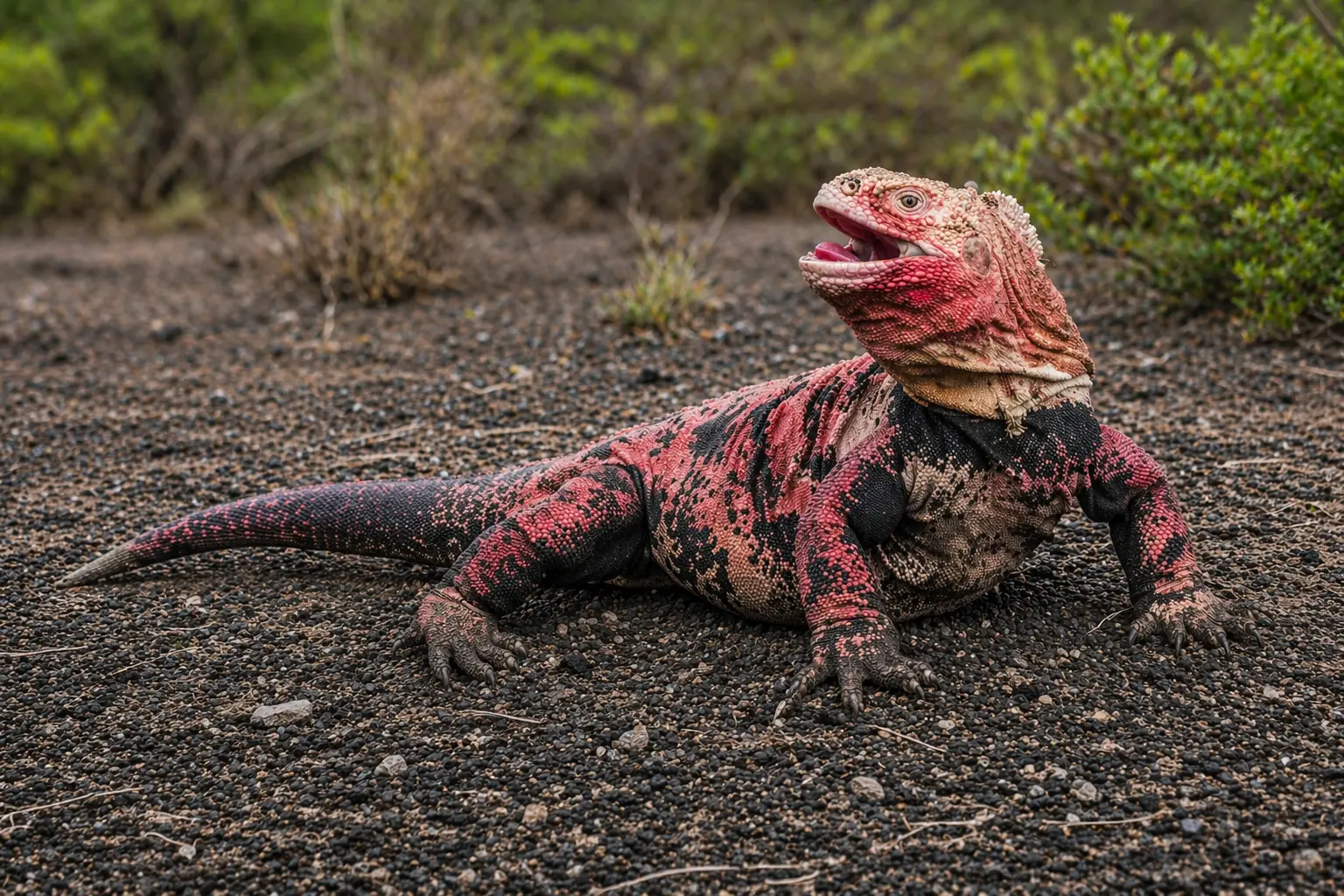
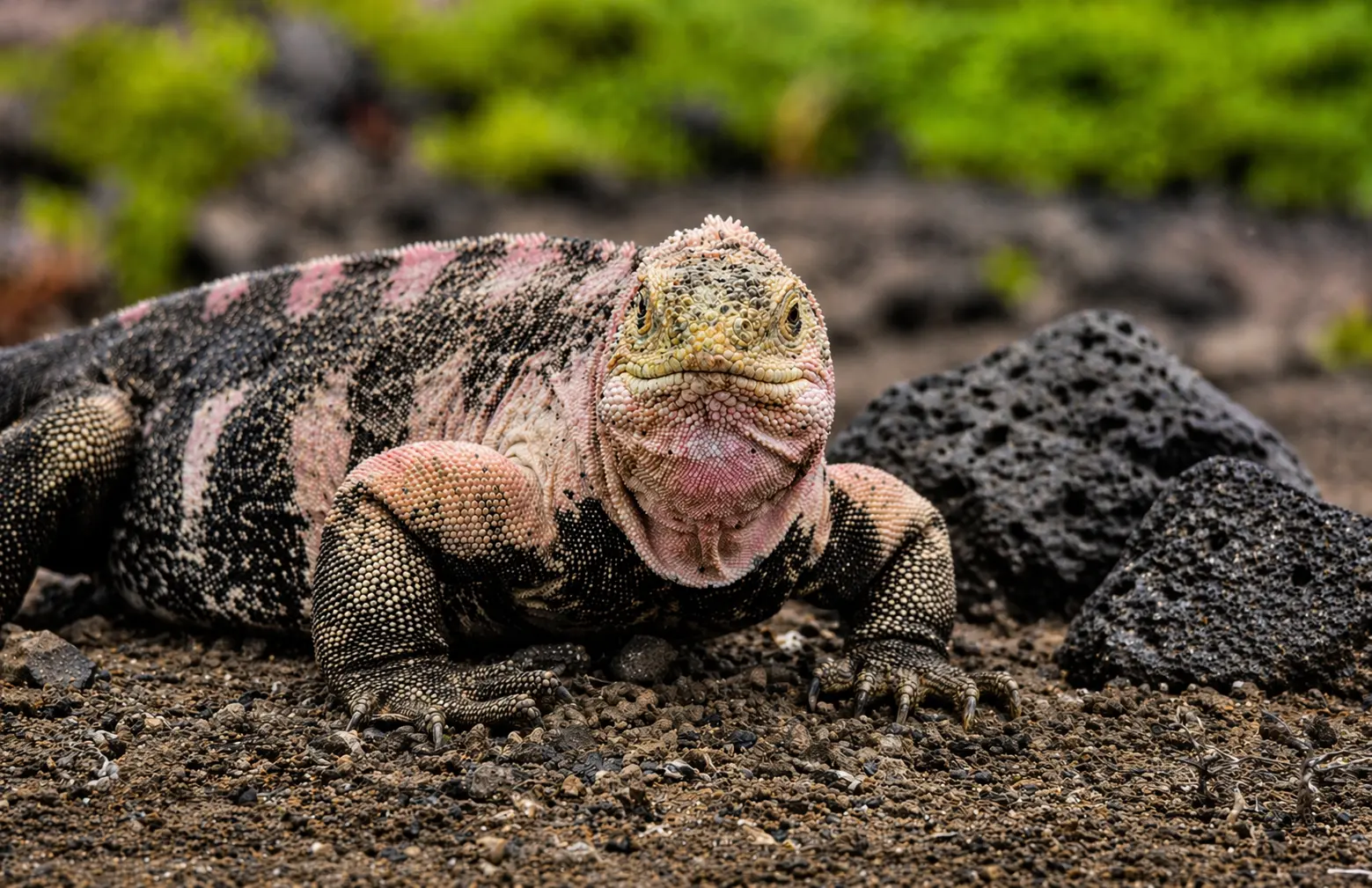
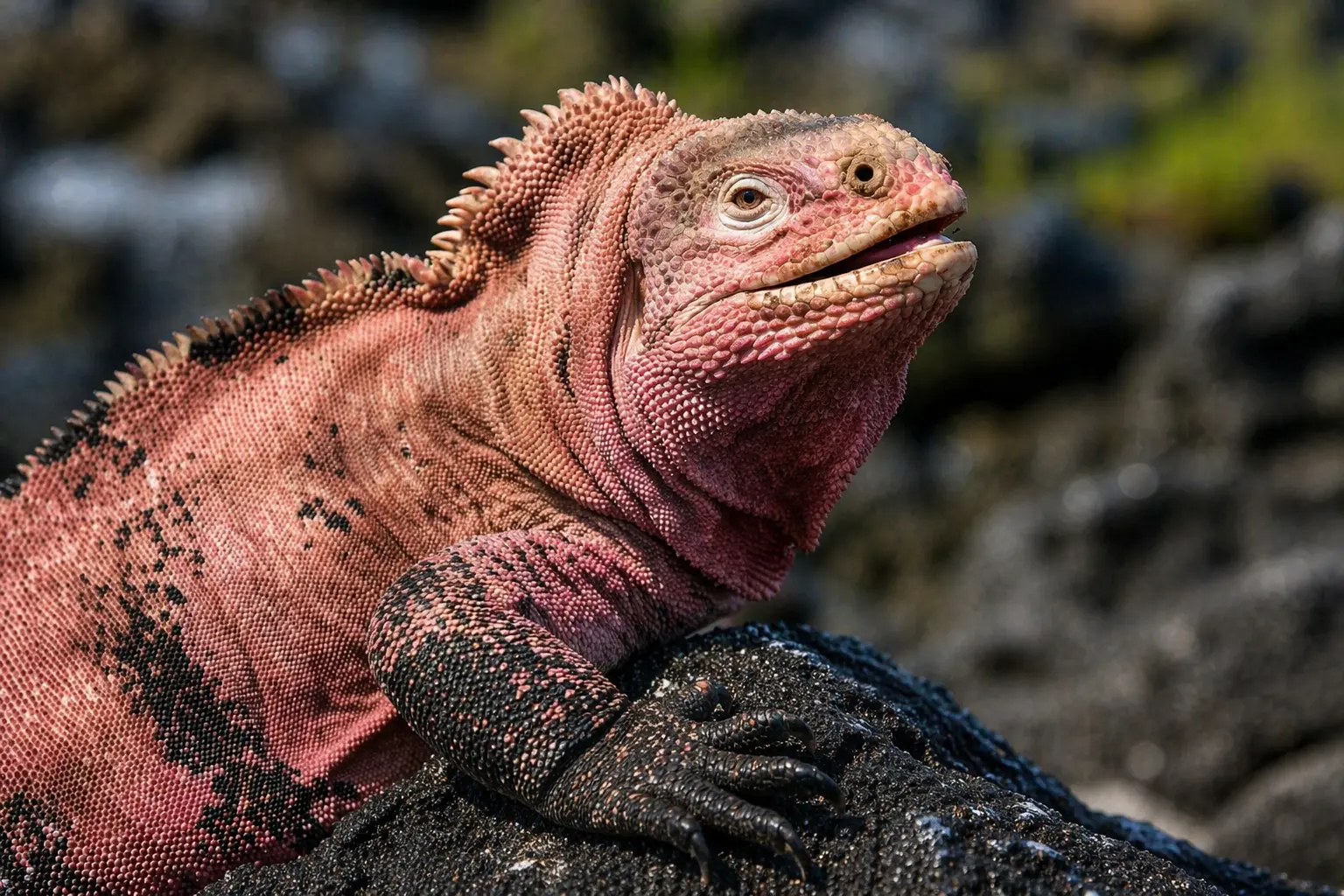
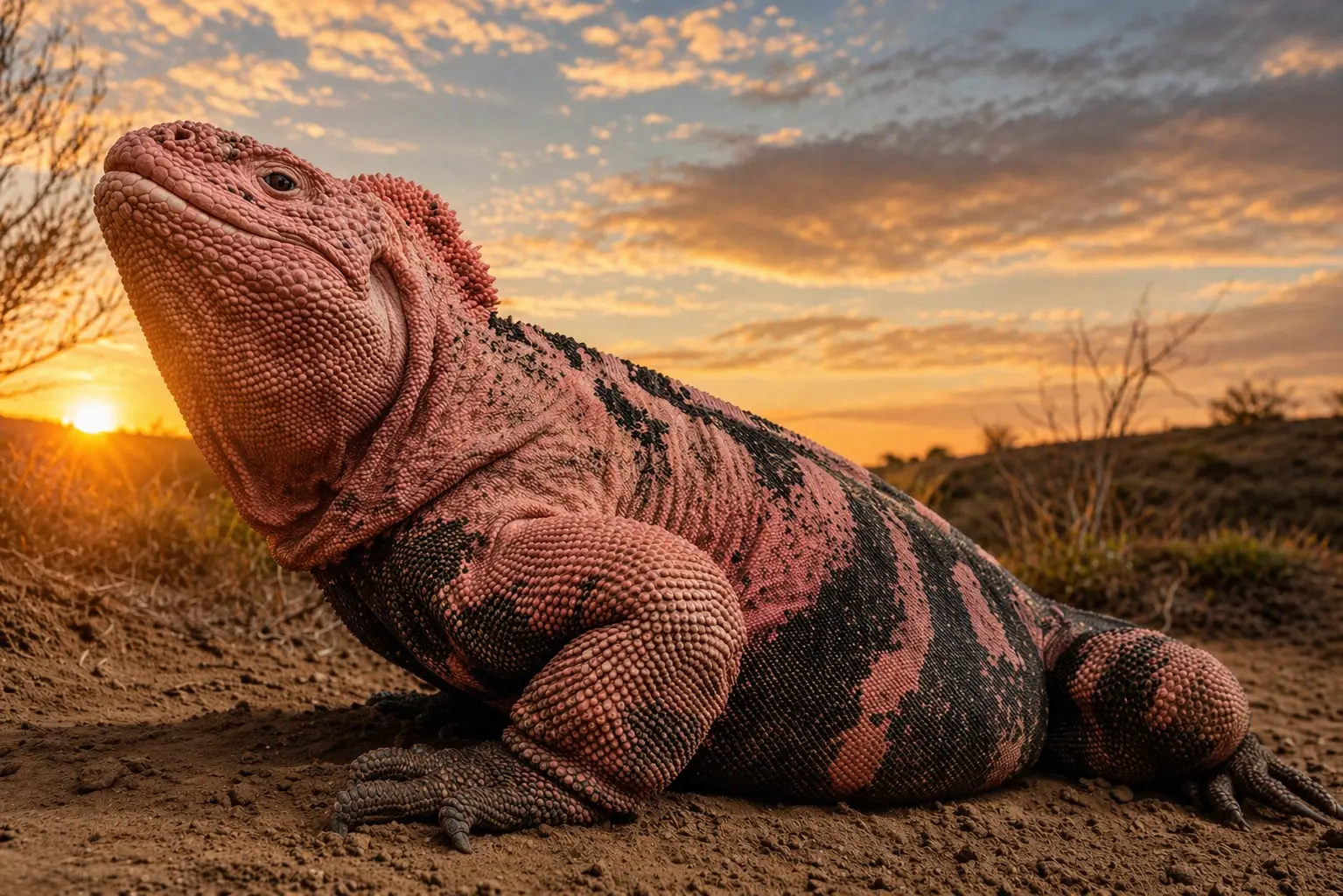
A large reptile steps into view—slow, deliberate, almost ghostlike against the black lava. Its body is soft pink, crossed by dark bands, its scales catching the morning light in one of the most improbable sights in the Galápagos.
This is the Galápagos pink land iguana, Conolophus marthae—one of the rarest reptiles on Earth.
Fewer than 300 individuals are believed to survive, all confined to the slopes of a single volcano on northern Isabela Island. Yet rarity is only part of what makes this animal extraordinary. Although science formally recognized the species only in 2009, genetic studies suggest that this iguana has been present in the Galápagos as a distinct species for roughly 5.7 million years, making it one of the archipelago’s most ancient living species.
A Discovery Hidden in Plain Sight
The pink iguana first came to scientific attention in 1986, when rangers from the Galápagos National Park Directorate encountered unusually colored land iguanas during field surveys on Wolf Volcano.
At the time, the animals were thought to be an unusual form of the more familiar Galápagos land iguana, Conolophus subcristatus. The mystery remained unresolved for more than two decades.
Only in 2009, after detailed research by scientists including Gabriele Gentile and Howard Snell, was the pink iguana formally described as a distinct species.
The finding surprised the scientific community. Genetic studies indicated that the pink iguana has persisted as an independent species in the Galápagos for around 5.7 million years. In other words, an animal representing one of the archipelago’s oldest known living forms had remained scientifically unrecognized until the 21st century.
Fuente: Plan de Conservación y Manejo de la Iguana Rosada de Galápagos (2022-2027). Dirección del Parque Nacional Galápagos y UICN.
That alone makes the species remarkable. But on Wolf Volcano, scientific recognition came only after something even more fundamental: years of quiet survival in one of the most remote and unforgiving corners of the islands.
Why Is It Pink?
The pink iguana’s most striking feature, of course, is its color.
Unlike the yellow and golden tones typical of other Galápagos land iguanas, this species has a salmon-pink body marked by dark vertical bands. Its unusual appearance is linked to the structure of its skin. Rather than being dominated by strong pigments, the scales allow blood vessels beneath the surface to influence the animal’s coloration, producing its distinctive tone.
But adults are not born that way.
Hatchlings emerge green, marked with darker patterns that help them blend into vegetation and rocky terrain. As they grow, the structure of the skin changes and the green gradually gives way to pink. This natural transition from green to pink occurs as the animal matures.
It is one more reminder that the pink iguana is not simply unusual in color. It is unusual in appearance, in biological identity, and in how little it revealed of itself to science until recent decades.
Breaking the Silence
For years, one question haunted the species’ future.
Adult pink iguanas could still be found on Wolf Volcano. But juveniles were almost never seen.
That absence raised a troubling possibility: perhaps the population was aging, but failing to produce enough surviving young to sustain itself. A species can persist in the landscape and still be quietly slipping toward disappearance.
Now, after decades of uncertainty, that silence is beginning to break.
Recent expeditions between 2022 and 2025, led by the Galápagos National Park Directorate together with conservation partners, have begun to change the picture. Researchers located the first confirmed nesting areas for the species and documented hatchlings and young iguanas for the first time.
One of the most encouraging signs came in March 2025, when scientists recorded a juvenile weighing more than two kilograms—clear evidence that at least some young iguanas are surviving long enough to reach safer size classes.
For conservationists who have worked for years under the shadow of doubt, that finding matters enormously. It does not mean the species is safe. But it does suggest that reproduction is happening, and that at least part of a new generation is managing to survive.
The shift may be linked, in part, to ongoing efforts to control invasive predators such as feral cats and black rats, which threaten eggs and hatchlings before they have a chance to grow.
Living on the Edge of Fire
Even with these encouraging signs, the pink iguana remains one of the most vulnerable species in the Galápagos.
Its entire known population survives on the slopes of Wolf Volcano—an active volcano that erupted as recently as 2022. Few species live under such narrow geographic limits, and fewer still under the constant possibility of sudden geological disturbance.
The risks do not end there.
Scientists are also examining biological factors that could shape the species’ future. A recent study published in Acta Tropica in 2024, led by researchers including Ainoa Nieto-Claudín and Gabriele Gentile, identified a previously unknown herpesvirus associated with the Galápagos pink land iguana.
So far, researchers do not view the virus as evidence of an immediate crisis. It may instead reflect a long-standing biological relationship associated with the species’ long history on Wolf Volcano. Still, small populations are inherently fragile.
Disease, climate variability, habitat disturbance, and volcanic activity can all carry outsized consequences when an entire species is restricted to a single place.
Conservation on the Roof of the Galápagos
Protecting the pink iguana is among the most demanding conservation challenges in the archipelago.
Reaching its habitat requires a steep 10- to 12-hour climb across harsh volcanic terrain to elevations approaching 1,700 meters above sea level. This is conservation carried out far from roads, visitor sites, or easy logistics—on the exposed upper slopes of an active volcano.
The responsibility for safeguarding the species rests with the Galápagos National Park Directorate, whose rangers lead field expeditions and long-term monitoring on Wolf Volcano. Their work has been essential not only in documenting the iguana’s status, but in sustaining the long effort needed to protect it.
Scientists from Galápagos Conservancy have also played a central role, helping build the scientific foundation for conservation through years of research on the species’ genetics, ecology, and health. More recently, Fundación Jocotoco has joined the effort, contributing specialized work to control invasive predators, especially feral cats and rodents that threaten eggs and young iguanas.
Together, these institutions are doing something extraordinarily difficult: trying to secure the future of a species found nowhere else on Earth, in a habitat that remains both biologically unique and physically unforgiving.
A Living Secret Still Holding On
The pink iguana is more than a rare reptile. It is one of the Galápagos Islands’ most powerful reminders that even here—perhaps the most celebrated natural laboratory on Earth—nature still holds secrets.
For decades, this species remained scientifically hidden on the upper slopes of a remote volcano, carrying within it a biological history that reaches back millions of years. Today, it stands at the intersection of fragility and persistence: an animal so restricted, so vulnerable, and yet still capable of surprising science with signs of life renewed.
Its future is far from secure.
But for now, on the dark volcanic heights of Wolf Volcano, the story is no longer only about rarity or loss. It is also about endurance—and about the possibility that, after years of uncertainty, a new generation is beginning to emerge.