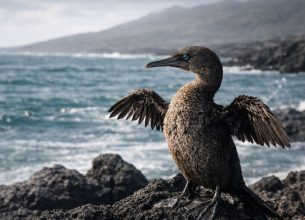

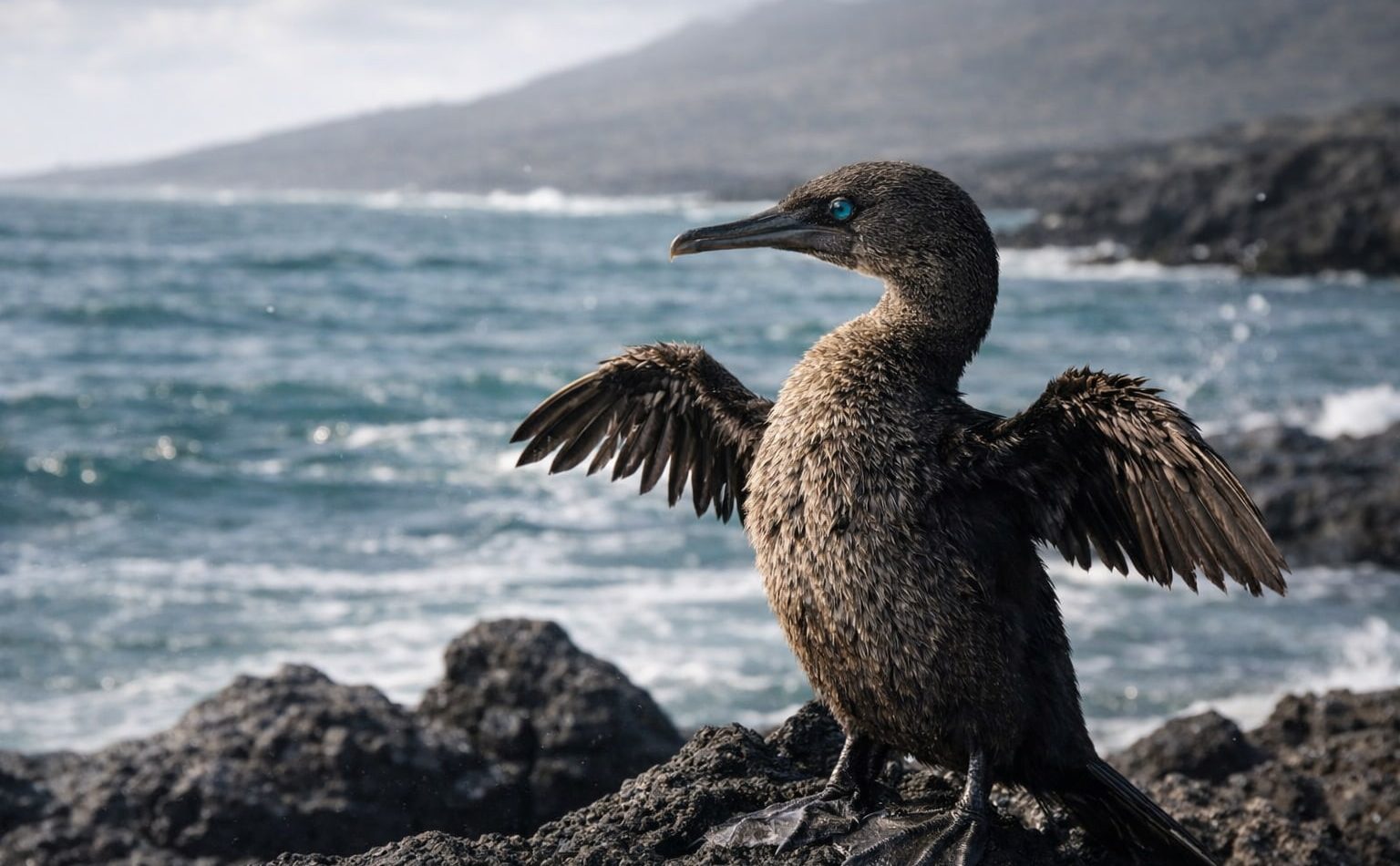

Along the young lava shores of Fernandina Island, where the Pacific meets fresh volcanic rock, a dark seabird stands facing the wind.
It slowly opens its wings to the rising sun.
For a moment, it looks as if it might take flight.
But it never will.
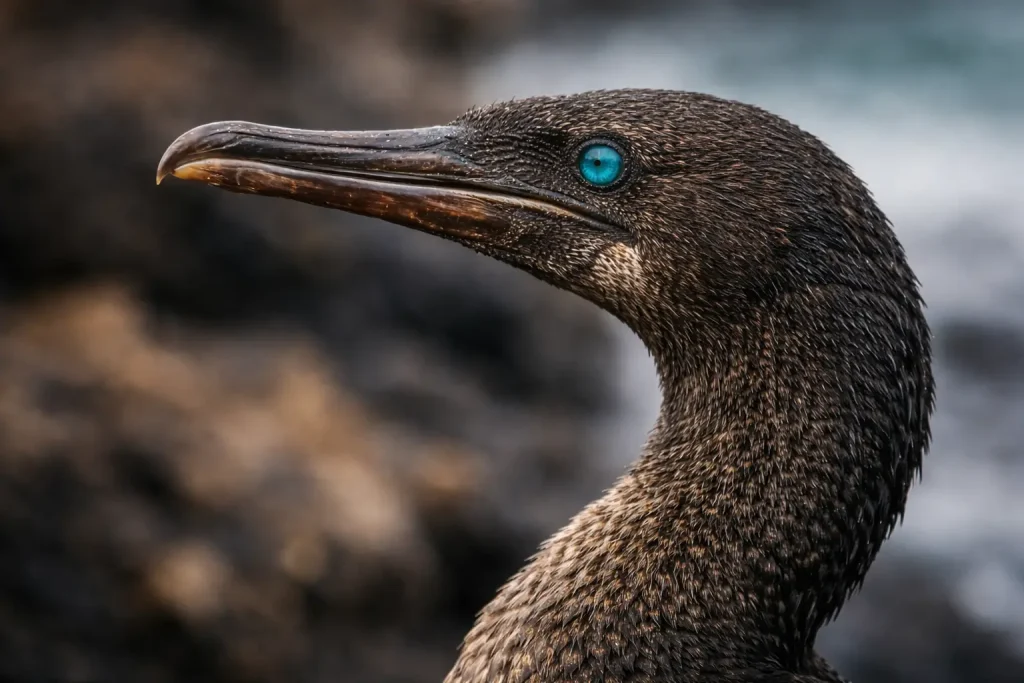
This is the Galápagos flightless cormorant (Nannopterum harrisi), one of the rarest seabirds on Earth and a species found nowhere else on the planet. Its turquoise eyes scan the water while it dries its feathers after a dive.
Instead of ruling the sky like most seabirds, this cormorant mastered a different world—the ocean below.
Its story offers one of the clearest examples of natural adaptation in the Galápagos.
1. It Left the Sky Behind for the Ocean
Most seabirds rely on flight to travel long distances in search of food.
The flightless cormorant followed a different path.
Over generations, its wings became dramatically smaller while its body grew heavier and more powerful. Today, the bird cannot fly at all. Instead, it has become a highly specialized underwater hunter.
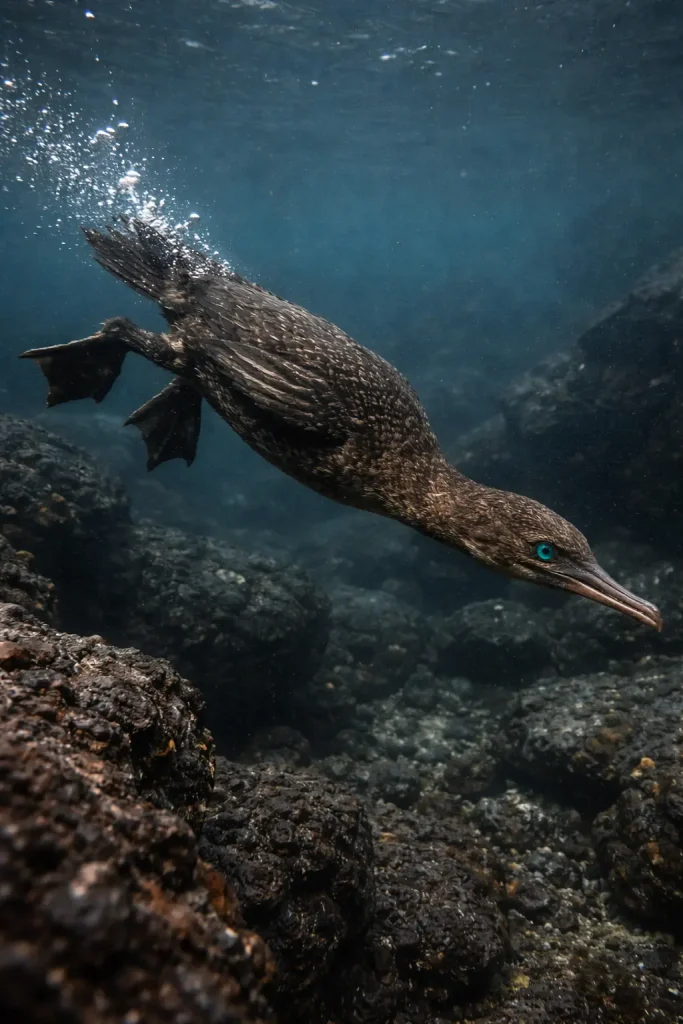
Using its strong webbed feet, it drives itself through the water in search of fish, octopus, and eels hiding among volcanic rocks.
Researchers have recorded dives of more than 60 meters, a remarkable depth for a coastal bird.
In the cold, productive waters of western Galápagos, life underwater proved more valuable than life in the air.
2. Its Wings Work Better Underwater Than in the Sky
At first glance, the wings of the flightless cormorant can look almost unfinished—too small for such a large bird.
Underwater, however, they serve a different purpose.
Unlike most cormorants, which use their wings to “fly” beneath the surface, the Galápagos species depends almost entirely on its powerful legs for propulsion. Its shortened wings act mainly as stabilizers, helping it turn and maneuver while hunting along the seafloor.
This body design reduces drag and allows the bird to pursue prey through narrow spaces between lava rocks.
What looks like a loss on land becomes an advantage underwater.
3. Its Feathers Are Meant to Get Wet
Visitors to the islands often see flightless cormorants standing on black lava rocks with their wings spread wide toward the sun.
The pose may look dramatic, but it serves a practical purpose.
Unlike most seabirds, the feathers of the flightless cormorant are not fully waterproof. If they were, trapped air would make the bird more buoyant and much less efficient underwater.
This trade-off helps it sink quickly when hunting along the seafloor.
After each dive, however, the feathers need time to dry. That is why these birds are so often seen with their wings open along the shoreline.
4. Its Skeleton Changed for a Life in the Sea
For decades, scientists wondered how a seabird could lose the ability to fly.
Genetic research has helped explain part of the answer.
Studies led by scientists from UCLA and collaborating institutions identified mutations in genes linked to cilia—tiny cellular structures that play an important role in bone development during growth.
Those changes affected the bird’s skeleton. One of the clearest differences appears in the keel of the sternum, the bone where strong flight muscles would normally attach. In the flightless cormorant, that structure is greatly reduced.
At the same time, the bird developed a heavier body and stronger legs, traits that make it better suited for swimming and diving.
Rather than simply losing flight, this species shifted fully toward life in the ocean.
5. Even Its Nest Comes From the Sea
During the breeding season, flightless cormorants build their nests on low lava platforms or small pebble beaches just above the tide line.
But these are no ordinary nests.
Males often bring gifts from the seafloor—sea urchins, starfish, and strands of algae—and arrange them into raised nest structures just inches above the water.
Part courtship display and part engineering, the nest helps protect eggs from waves while revealing something essential about the bird’s world: even its home is built from materials gathered from the sea.
A Bird Bound to One Small Corner of the Ocean
The Galápagos flightless cormorant occupies one of the smallest ranges of any seabird on Earth.
Its entire population—estimated at around 2,000 birds—lives only along the western coasts of Isabela and Fernandina, within the Galápagos Marine Reserve, where cold waters from the Cromwell Current create some of the most productive marine conditions in the archipelago.
Because of this extremely limited distribution, the species is listed as Vulnerable under Criterion D2 on the IUCN Red List, a category used for species whose survival depends on a very small geographic area.
A single catastrophic event—such as a strong El Niño, a disease outbreak, or volcanic disturbance—could affect a large share of the population.
A Living Indicator of Ocean Health
The flightless cormorant is more than an unusual bird. It is also an indicator of the health of the Bolívar Channel, the nutrient-rich stretch of water between Isabela and Fernandina.
When cold currents bring abundant marine life to the region, the birds thrive. When ocean conditions shift—especially during strong El Niño events—fish become less available and breeding success can decline sharply.
Because this cormorant cannot fly to new habitats, it remains tied to one narrow coastline shaped by lava, currents, and cold, productive seas.
Its future reflects the health of the ocean itself. Protecting it means protecting the marine system that sustains life across the archipelago.
To protect the flightless cormorant is to protect the fragile marine system that made it possible—a narrow, powerful world on which far more than one bird depends.