

The Gathering at Darwin and Wolf
At the northern edge of the Galápagos archipelago, far beneath the open Pacific, one of the ocean’s most extraordinary gatherings unfolds.
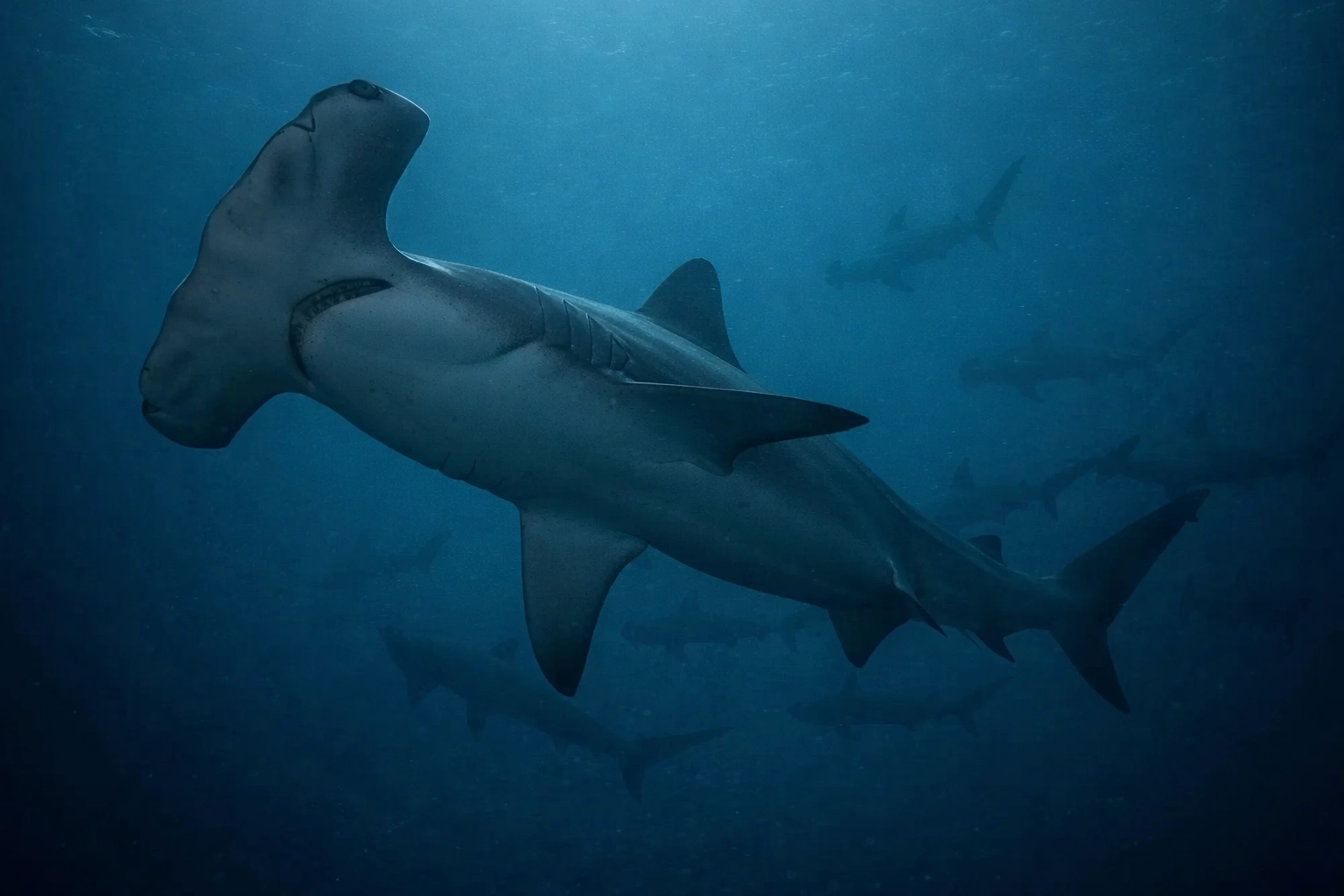
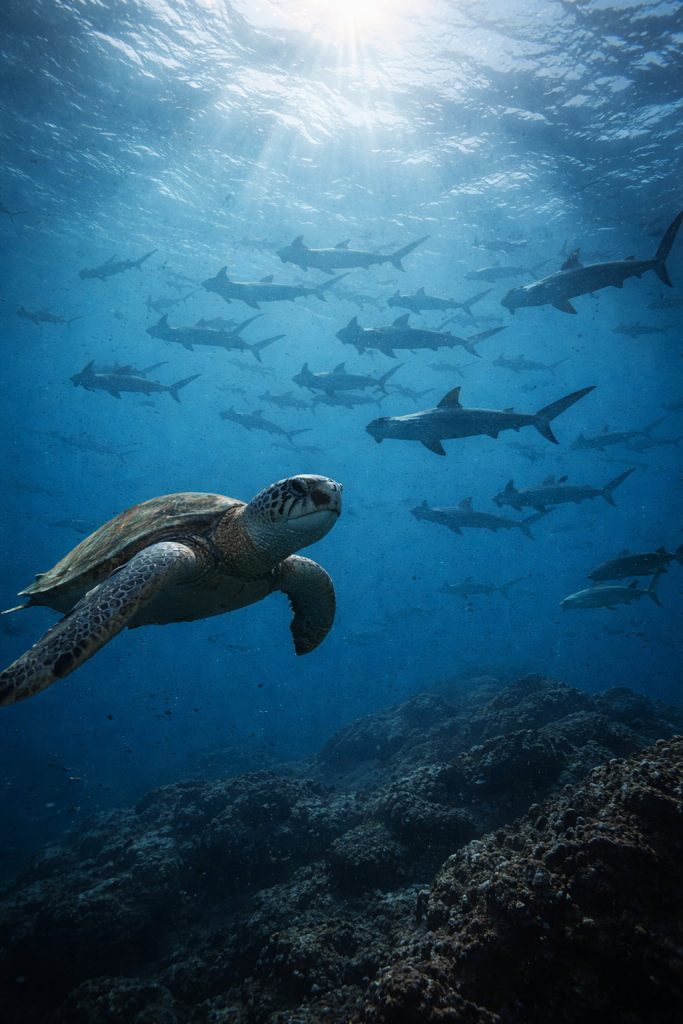
Around the volcanic seamounts of Darwin and Wolf, hundreds of scalloped hammerhead sharks (Sphyrna lewini) move in sweeping schools, circling the submerged peaks in numbers rarely seen anywhere else on Earth.
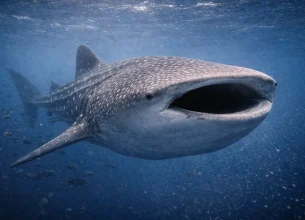
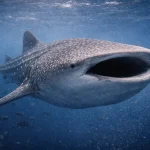
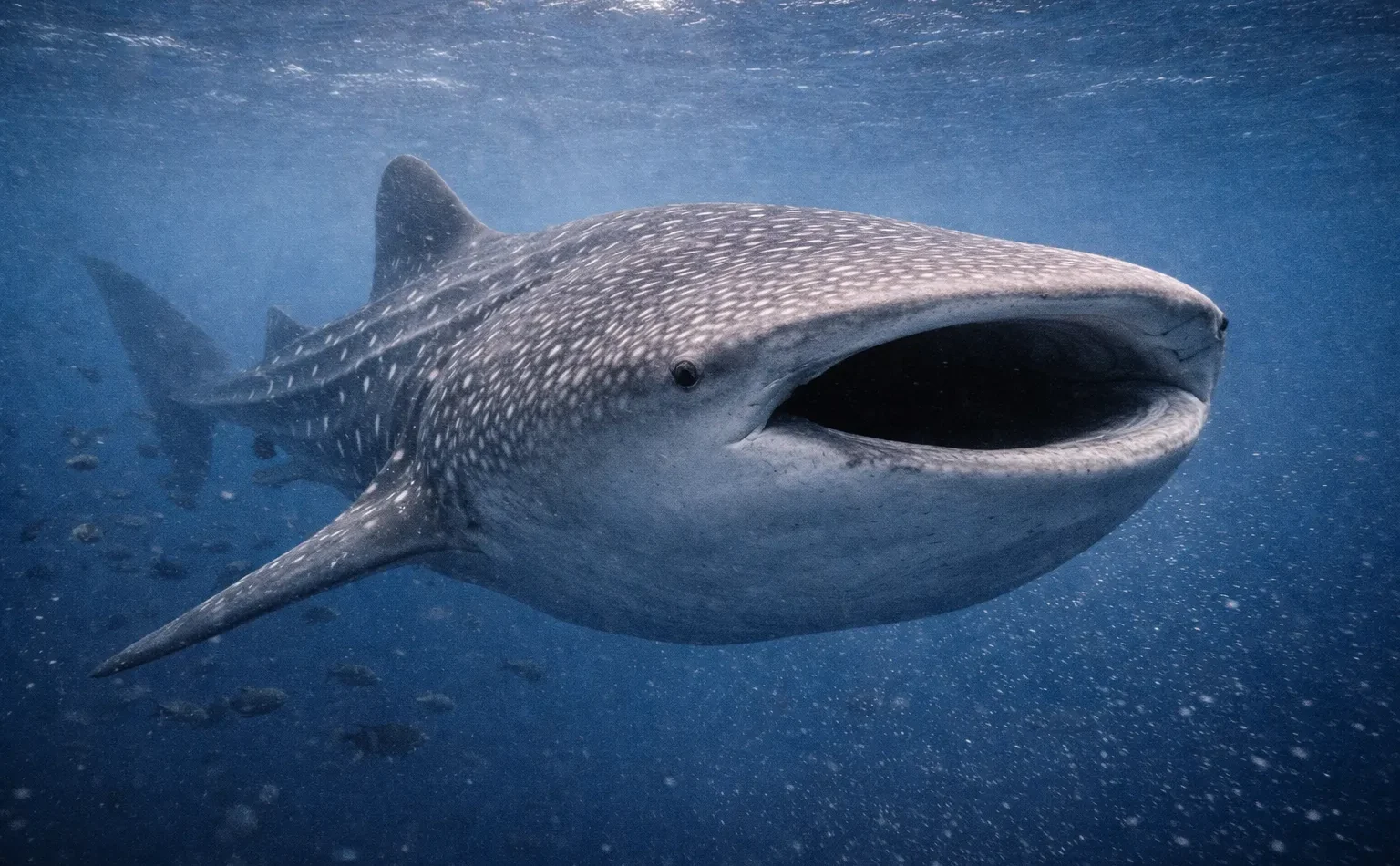
Nearby, a shadow nearly 40 feet long glides through the deep blue—a whale shark, the largest fish in the ocean, following ancient migratory routes shaped by currents invisible to the human eye.
This is no empty marine wilderness. It is one of the great crossroads of the Tropical Eastern Pacific, where ocean currents, underwater geology, and migratory species come together in spectacular abundance.
The Hidden Engine of Life
The extraordinary richness of Galápagos waters is no accident. It is driven by a rare oceanographic convergence.
The archipelago lies where several major current systems meet. The cold, nutrient-rich Humboldt Current arrives from the south. The Panama Current brings warmer waters from the north. Beneath them, the Equatorial Undercurrent—better known as the Cromwell Current—flows eastward below the surface and collides with the volcanic platform of the islands, helping drive the upwellings that make these waters so productive.
As deep, cold water rises toward the surface, it carries nutrients that fuel the growth of plankton, the microscopic foundation of a vast marine food web.
From drifting organisms to tuna, sea lions, sharks, and whales, life across the Galápagos Marine Reserve depends on this hidden engine.
A Vast Architecture of Protection
Because of the global importance of these waters, Ecuador has built one of the most ambitious marine protection systems in the world.
The Galápagos Marine Reserve, created in 1998, protects 55,120 square miles (142,759 square kilometers) of ocean surrounding the archipelago. It safeguards key ecosystems while regulating local fisheries and protecting one of the planet’s most important marine refuges.
In 2022, Ecuador added the Hermandad Marine Reserve, expanding protection by another 23,166 square miles (60,000 square kilometers). But Hermandad is more than an increase in size. It is a strategic corridor designed to help protect migratory routes linking Galápagos with Cocos Island in Costa Rica.
Together, the two reserves protect 78,286 square miles (202,759 square kilometers) of ocean. Within Hermandad, different management zones add an important layer of protection, including areas with full no-take status and others where longline fishing is prohibited.
For many pelagic species, that protected space is not abstract. It is essential.
The Corridor Beyond Borders
The true significance of Hermandad lies in connectivity.
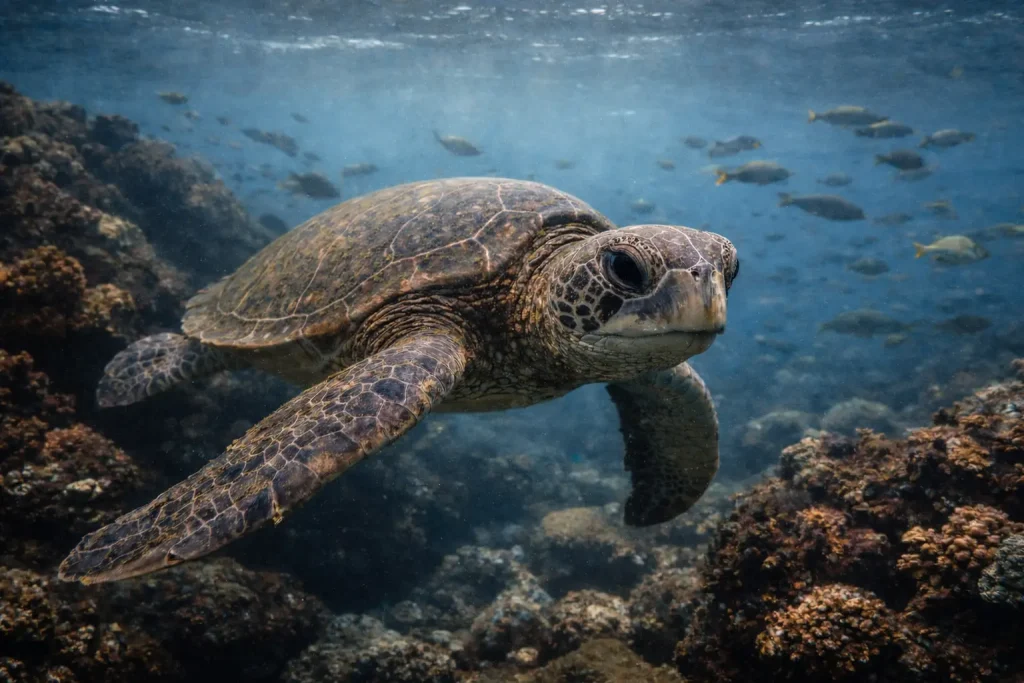
For green sea turtles, manta rays, whale sharks, and large sharks, the ocean has no political boundaries. Their survival depends on moving safely across immense distances between feeding grounds, breeding areas, and migratory routes that have existed for generations.
That is why Galápagos can no longer be understood as an isolated sanctuary. It is part of a broader regional conservation vision across the Tropical Eastern Pacific, including the marine protected areas of Ecuador, Costa Rica, Colombia, and Panama.
This growing network is often linked to the idea of the Coco–Galápagos migratory corridor, sometimes referred to as the Migravía, and to the broader Eastern Tropical Pacific Marine Corridor. Together, these efforts reflect a simple reality: highly mobile species cannot be protected by one reserve alone.
A Sanctuary Under Pressure
Despite its scale, this blue frontier remains under constant pressure.
Large industrial fishing fleets often operate just beyond the reserve’s boundaries, concentrating effort along the edges of protected waters. The threat is not only the number of vessels. It is also the pressure placed on migratory species that cross invisible borders and become vulnerable the moment they leave the reserve.
The scalloped hammerhead shark, one of the most iconic species around Darwin and Wolf, is now listed as critically endangered on the IUCN Red List, largely because of overfishing, illegal fishing, and the global demand for shark fins.
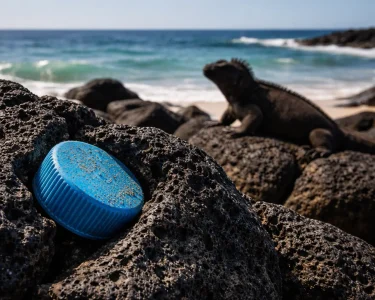
Climate change adds another layer of uncertainty. Rising ocean temperatures can alter the delicate current systems that sustain Galápagos productivity, while plastic pollution continues to spread across even remote marine habitats.
Science on the Front Line
Protecting these waters requires more than boundaries on a map.
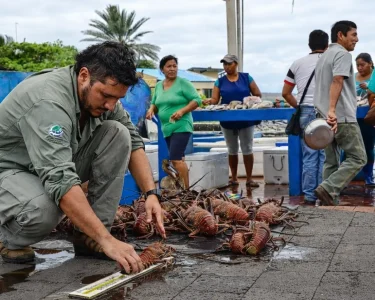
The Galápagos National Park Directorate leads monitoring and patrol efforts across the reserve, supported by specialized vessels, satellite surveillance, and international cooperation. But enforcement alone is not enough.
Scientific research remains one of the most important tools in marine conservation. By tracking sharks, studying currents, monitoring reef systems, and documenting changes in species distribution, scientists help turn ecological knowledge into management decisions.
In Galápagos, science is not only about understanding nature. It is also one of the strongest lines of defense available to protect it.
The Blue Heart of the Pacific
In the deep waters surrounding Darwin and Wolf, great schools of hammerhead sharks continue their endless circuits.
Their presence is a reminder of what the ocean can still hold when productivity, protection, and time are allowed to work together.
By protecting 78,286 square miles (202,759 square kilometers) of marine sanctuary, Ecuador has helped secure one of the Pacific’s most important strongholds for ocean life. But the meaning of this place extends far beyond its boundaries.
What happens in Galápagos matters across the wider Pacific. To protect this blue heart is to protect migratory routes, food webs, and one of the most extraordinary concentrations of marine life left on Earth—while there is still time.